I recently set up the Connections Project with the aim of supporting young people to understand the complex and interdependent connections between different living species in our urban environment. Nothing exists in isolation, including humans and, so, to really grasp the concept of biodiversity and the current crisis of our planet, I wanted to highlight those connections through an engaging, multi-sensory venture.
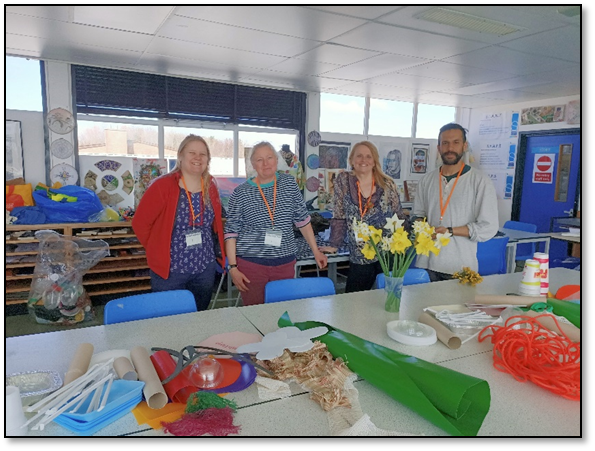
Before I realized any funding for this idea, Juliette, from Seadream CIC, and Jane, from Plymouth Scrapstore, joined me, Elizabeth, from the Rebel Botanists, to help turn this idea into a workable plan. Within a matter of only a few weeks the plan matured into a reality: we received funding from several generous P.C.C. councillors, put together our team of facilitators and delivered a pilot project to 30, Year 7, students at Stoke Damerel Community College.
My rationale for this was based on our present climatic and environmental situation because, surely, if these connections were already being made, we wouldn’t be in this predicament? For example, whilst many people may be aware of the plight of bees and the resurgence in bee-keeping, do they fully understand the required habitats and nectar sources to support them? We may know that earthworms are a sign of a healthy soil, but why is that? What is the importance of earthworms and bee pollination to the human race? And, what is the implication of applying pesticides to life below, on and above the soil?
In many aspects of our lives, we learn about things but miss the connections. School subjects are frequently considered apart: how often do you hear comments like, “I really like art, but I hate maths”? Well, think how these subjects are linked… many techniques in art are based upon maths: shapes, angles, perspective, rule of halves, rule of thirds, grid technique, the Golden Ratio and Pi. Then consider how history, culture and social commentary are reflected and communicated through art. Reflect also upon the self-expression and creative skills being developed which are much needed personal and professional attributes in our rapidly-changing world, where new design concepts and job roles are required. The Connections Project makes visible the inter-curricula, or perhaps I should say the intra-curricula, and therefore encourages participants to develop a more holistic perspective in their learning.
The initial pilot project was also experimental in terms of:
- selecting the most relevant content to present
- highlighting the connections between the workshop topics
- how effective the delivery would be to meet the aims of the project
- how we would gather evidence of existing knowledge and use that to enhance understanding
- the timings of the workshops
- how this would fit into the school timetable
- what long-term benefits may come from this
- being an inquiry to how valuable and needed this holistic approach might be to secondary schools, to complement existing teaching and learning.
After discussions with Louise McManus from Stoke Damerel Community College, we decided on delivering 3 workshops: soils, urban wild plants and pollinators; these would link and highlight the importance of healthy habitats, the cycle of life and human impact. This would culminate in a final art workshop, where participants would evidence their understanding through the creation of a final art installation. Each workshop would be tailored to ensure every voice counts through small group Q & A discussions and individual engagement with hands-on activities.
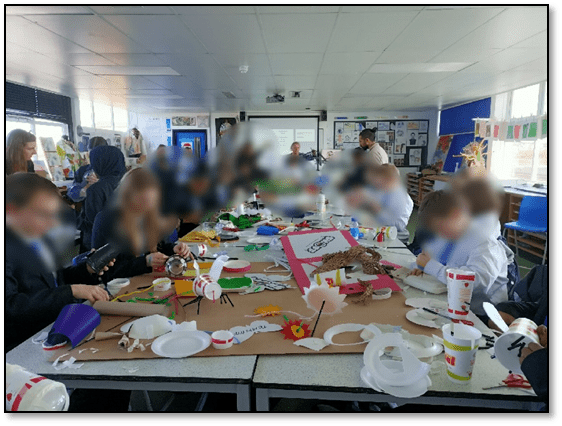
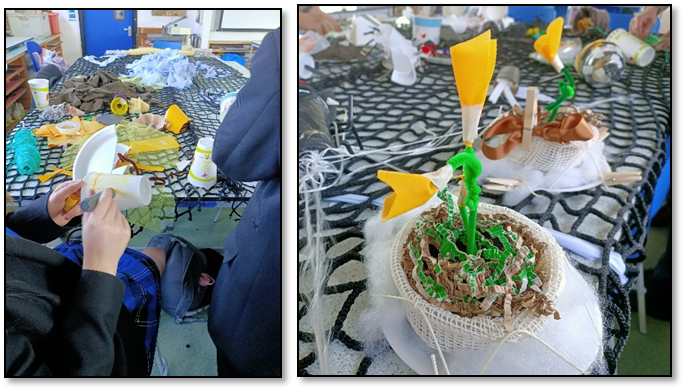
The final art workshop demonstrated the understanding of the workshop themes. It was really encouraging to see how the students eagerly started, clearly having ideas in their minds from the outset. They modelled different species to work within an ecosystem, e.g. bees, butterflies, dragonflies and spiders, with a web, whilst some created jellyfish and a sea turtle. Other students created a mini-eco-system illustrating the connections between soil, leaf litter, tree stumps, plants, earthworms and tardigrades. Throughout this creative activity, students talked with each other and were clearly fully enthralled with the task, considering techniques of how they might craft their structures. They asked the facilitators subject-specific questions about stamens, bark and particular insect and flower features. Some of the unprompted feedback was lovely to hear:
“Thank you, I really enjoyed learning about soil, it was really interesting”… “I’m having the best day!”…”When are you coming back?”
Well, we are happy to go back and revisit this school, and the good news is that due to the generosity of the councilors who supported our project, we have enough money to fund another event in a school. So, thank you to the kind support of the following Plymouth City councilors: Margaret Corvid, Sue Dann, Sally Cresswell, Jemima Laing and Sarah Allen. We would also like to thank Louise McManus and the staff at Stoke Damerel Community School for providing us the opportunity to trial this project with their pupils.
If you would like to find out more about the Connections Project please email: rebelbotanists@gmail.com
Elizabeth Richmond – Connections Team Project Lead
 #RebelBotanists